
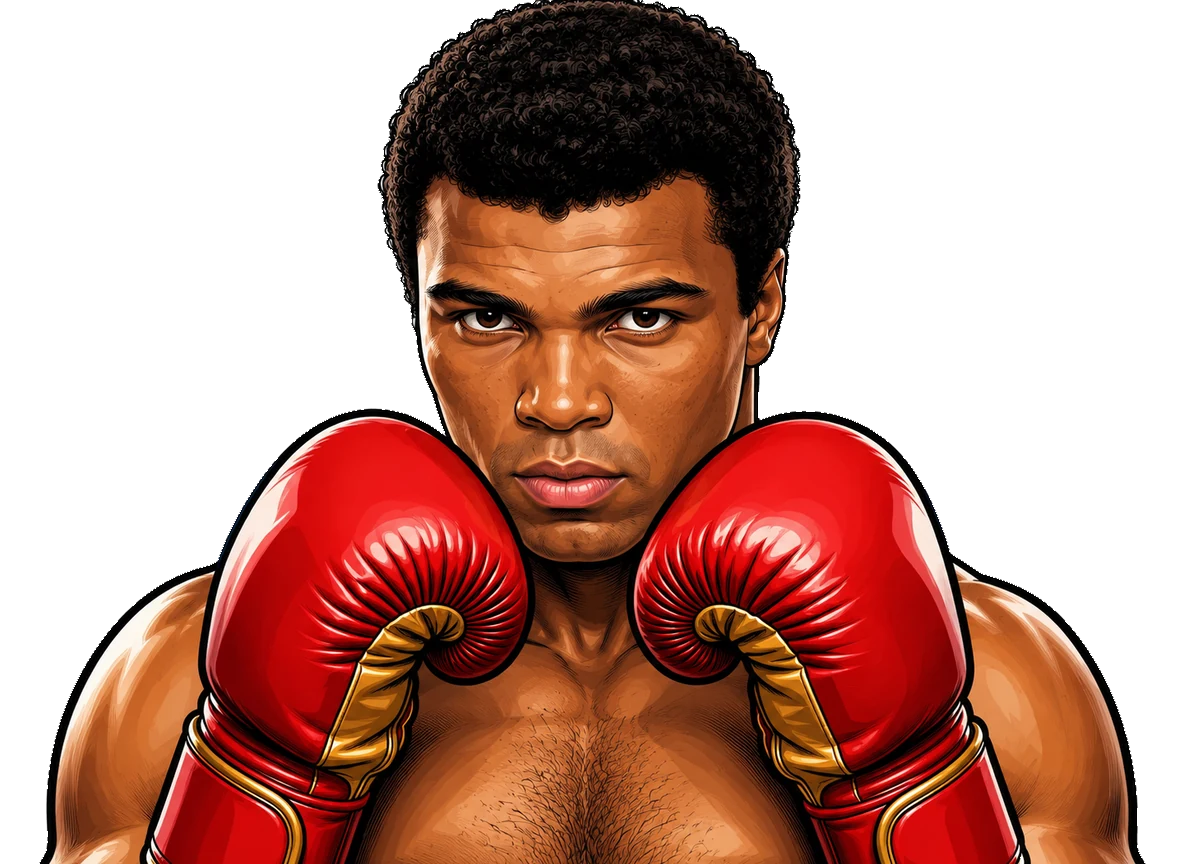
 FF Legends
Why Ali is a legend
Muhammad Ali called himself The Greatest. Sports Illustrated and the BBC later named him the sportsman of the twentieth century.
He brought a welterweight's speed to the heavyweight division, gliding around the ring at 6 foot 3, taunting champions and calling the round they would fall. In 1967 he refused the Vietnam draft on religious grounds and was stripped of his title, losing more than three years of his prime. That stand made him a symbol of conscience and civil rights far beyond sport.
He came back to become the first man to win the heavyweight championship three times, beating George Foreman in the Rumble in the Jungle and Joe Frazier in the Thrilla in Manila, two of the most famous nights in sporting history.
In 1996, his hands trembling from Parkinson's, he lit the Olympic flame in Atlanta before a stadium on its feet and a watching world.
Defining fights
Sonny Liston had knocked out Floyd Patterson twice in the first round, and most people in boxing believed he would do the same to 22-year-old Cassius Clay. Clay was an 8–1 underdog in Miami Beach. He spent the build-up calling Liston the big ugly bear and turned the weigh-in into a shouting fit that convinced some reporters he was terrified.
From the first bell Clay was too fast for him, and in the third he opened a cut under Liston’s eye. In the fifth something burned Clay’s eyes, possibly liniment from Liston’s gloves, and he could barely see. He begged Angelo Dundee to cut his gloves off. Dundee sent him back out and told him to keep moving, and Clay survived the round almost blind. Once his eyes cleared he took over again. Liston stayed on his stool at the start of the seventh.
“I shook up the world!” Clay shouted from the ropes. Days later he announced he had joined the Nation of Islam, and within weeks he was Muhammad Ali. The new champion would become one of the most famous people on earth, and the night in Miami remains one of the greatest upsets in heavyweight history.
George Foreman was 40–0 with 37 knockouts, the undisputed heavyweight champion at 25, and he had just destroyed Joe Frazier and Ken Norton inside two rounds each. Muhammad Ali was 32 and widely expected to be hurt. Don King persuaded President Mobutu Sese Seko to stage the fight in Kinshasa, Zaire, for a $5 million purse each. A cut over Foreman’s eye in sparring pushed it back five weeks, and Ali spent them winning over the country. Everywhere he went, crowds chanted “Ali, bomaye!”
The bell rang at 4am in the 20th of May Stadium so America could watch live in prime time, in front of 60,000 people. Ali surprised Foreman with right-hand leads in the first round. Then he went to the ropes, covered up and let the champion pound his arms and body, round after round, taunting him in the clinches: “They told me you could punch, George!” Foreman punched himself out. In the eighth Ali came off the ropes with a sudden combination, a left hook and a straight right, and Foreman spun to the canvas and was counted out.
Ali was heavyweight champion again, seven years after the title had been taken from him. The rope-a-dope entered the language. The Ring named it the Fight of the Year and the eighth its Round of the Year, and the documentary When We Were Kings won an Oscar in 1997. Foreman would need 20 years to win the title back.
By 1975 Muhammad Ali and Joe Frazier had split two fights and shared four years of bad blood. Frazier had handed Ali his first defeat in the Fight of the Century, and Ali had evened the score in 1974. President Ferdinand Marcos brought the decider to the Philippines to put his country in front of the world, with the undisputed heavyweight title on the line and $14 million in purses. Ali spent the build-up calling Frazier “the Gorilla”, punching a gorilla doll as he rhymed about the thrilla in Manila.
The bell rang at 10am so the fight could go out live around the globe, under an aluminium roof that Frazier said pushed the ring past 120 degrees. Ali took the first two rounds. From the fifth, Frazier’s left hook began to land, and in the sixth it staggered him. After the ninth, Ali told his corner it was the closest he had ever come to dying. He found more in the 12th. In the 13th a right hand sent Frazier’s mouthpiece flying, and by the 14th Frazier could barely see. Eddie Futch stopped it before the last round as his fighter shouted “I want him, boss.” In the other corner, Ali had asked for his gloves to be cut off.
Frazier boxed only twice more. Ali fought on until 1981 and lost his title to Leon Spinks in 1978. HBO carried Manila on the first continuous satellite signal any network had delivered, to an estimated billion viewers. The Ring named it the Fight of the Year. Fifty years on, it is still held up as one of the most brutal fights in boxing history.
More famous fights
In the summer of 1963 Cassius Clay was the loudest young man in boxing, unbeaten and calling his shots on the way to a fight with Sonny Liston. He came to London, called Henry Cooper “a tramp, a bum and a cripple” and predicted he would win in five. Wembley Stadium held 35,000 people for its first open-air fight in 28 years.
Cooper, the British champion, was cut but kept coming. At the end of the fourth he landed the left hook of his life, and Clay fell back into the ropes and down as the round ended. Angelo Dundee hauled him to the corner and showed the referee that Clay’s glove had split. Legend says the delay bought Clay extra seconds to recover. In the fifth he tore into Cooper’s damaged left eye, and the referee stopped it at 2:15 with blood pouring down Cooper’s face, in the very round Clay had named.
Clay took back his insults. Cooper became a national treasure on the strength of one punch, the hook Britain still calls Henry’s Hammer. The split glove led to a rule that a spare pair must be kept at ringside. Three years later they met again at Highbury with the world title on the line, and Ali stopped Cooper on cuts in the sixth.
The rematch became one of the strangest nights boxing has known. Muhammad Ali’s new name and his membership of the Nation of Islam had made him a divisive figure, and talk of the mob followed Liston everywhere. The fight moved out of Boston and ended up in a junior hockey rink in Lewiston, Maine, in front of a small crowd.
Midway through the first round Liston jabbed, and Ali came over the top with a short right. Liston went down. Many in the arena never saw the punch land. Ali stood over him screaming “Get up and fight, sucker!” while referee Jersey Joe Walcott, the former champion, struggled to send him to a neutral corner and lost track of the count. Liston rose and they fought on until Walcott was told he had been down for well over ten seconds, and he stopped it.
Fans chanted “Fix!” and the arguments have never ended. Ali called it the anchor punch. The doubters called it the phantom punch. Neil Leifer’s photograph of Ali snarling over the fallen Liston became one of the most famous sports images ever taken, and Sports Illustrated chose it as the cover of its special issue on the century’s greatest sports photographs.
Muhammad Ali lost three and a half years of his career for refusing to be drafted into the army during the Vietnam War, stripped of his titles without losing a fight. In his absence Joe Frazier, a relentless left hooker from Philadelphia, became champion. When they finally met at Madison Square Garden on 8 March 1971, both men were unbeaten, both were guaranteed $2.5 million, and the country had split along political lines behind them.
Frank Sinatra worked ringside as a photographer for Life magazine because he could not get a seat. Ali won the early rounds with his jab, raising welts on Frazier’s face, then tired and leaned on the ropes. Frazier kept coming. In the 11th a left hook buckled Ali’s knees. In the 15th another left hook put him flat on his back. He was up at four with his jaw badly swollen and finished on his feet.
Frazier won a unanimous decision, handing Ali the first defeat of his professional career. The Ring named it the Fight of the Year. It opened a rivalry that would run through two more fights and decades of bitterness, and it is still one of the most famous nights in the history of sport.
Leon Spinks had won Olympic light heavyweight gold in Montreal in 1976 and had only seven professional fights behind him when he was picked to face Muhammad Ali for the heavyweight championship. Ali was 36. Spinks was a 10–1 underdog in Las Vegas, and few people believed the fight would be competitive.
Spinks refused to be overawed. He pressed from the opening bell, outworking the champion round after round with an energy Ali could no longer match. Ali rallied late and tried to steal it in the final rounds, and the 15th was fought at a furious pace. Two judges scored it for Spinks, 145–140 and 144–141. The third had Ali ahead by a point.
In only his eighth professional fight, Spinks was heavyweight champion of the world, one of the biggest upsets in the division’s history. Within weeks the WBC stripped him for choosing the Ali rematch over a mandatory fight with Ken Norton. Seven months later at the Louisiana Superdome, Ali won a unanimous decision to become the first man to win the heavyweight title three times.
Only on Fantasy Fights
FF points run every fight through today's Fantasy Fights scoring: 3 for a win, 1 more for a KO, minus 1 for being KO'd and 1 for each WBA, WBC, IBF or WBO belt at stake. Ranks are among every legend on Fantasy Fights.
Against other legends
Muhammad Ali's professional record
Muhammad Ali had 61 professional fights between 1960 and 1981: 56 wins (37 by knockout) and 5 losses. That is 2.8 fights a year, listed below from the last fight back to the first.
| # | Res | Opponent | How | Date |
|---|---|---|---|---|
| 61 | L | Trevor Berbick | UD 10 | 11 Dec 1981 |
| 60 | L | Larry Holmes Title | RTD 10 | 2 Oct 1980 |
| 59 | W | Leon Spinks Title | UD 15 | 15 Sep 1978 |
| 58 | L | Leon Spinks Title | SD 15 | 15 Feb 1978 |
| 57 | W | Earnie Shavers Title | UD 15 | 29 Sep 1977 |
| 56 | W | Alfredo Evangelista Title | UD 15 | 16 May 1977 |
| 55 | W | Ken Norton Title | UD 15 | 28 Sep 1976 |
| 54 | W | Richard Dunn Title | TKO 5 | 24 May 1976 |
| 53 | W | Jimmy Young Title | UD 15 | 30 Apr 1976 |
| 52 | W | Jean-Pierre Coopman Title | KO 5 | 20 Feb 1976 |
| 51 | W | Joe Frazier Title | RTD 14 | 1 Oct 1975 |
| 50 | W | Joe Bugner Title | UD 15 | 1 Jul 1975 |
| 49 | W | Ron Lyle Title | TKO 11 | 16 May 1975 |
| 48 | W | Chuck Wepner Title | TKO 15 | 24 Mar 1975 |
| 47 | W | George Foreman Title | KO 8 | 30 Oct 1974 |
| 46 | W | Joe Frazier | UD 12 | 28 Jan 1974 |
| 45 | W | Rudie Lubbers | UD 12 | 20 Oct 1973 |
| 44 | W | Ken Norton | SD 12 | 10 Sep 1973 |
| 43 | L | Ken Norton | SD 12 | 31 Mar 1973 |
| 42 | W | Joe Bugner | UD 12 | 14 Feb 1973 |
| 41 | W | Bob Foster | KO 8 | 21 Nov 1972 |
| 40 | W | Floyd Patterson | RTD 7 | 20 Sep 1972 |
| 39 | W | Alvin Lewis | TKO 11 | 19 Jul 1972 |
| 38 | W | Jerry Quarry | TKO 7 | 27 Jun 1972 |
| 37 | W | George Chuvalo | UD 12 | 1 May 1972 |
| 36 | W | Mac Foster | UD 15 | 1 Apr 1972 |
| 35 | W | Jürgen Blin | KO 7 | 26 Dec 1971 |
| 34 | W | Buster Mathis | UD 12 | 17 Nov 1971 |
| 33 | W | Jimmy Ellis | TKO 12 | 26 Jul 1971 |
| 32 | L | Joe Frazier Title | UD 15 | 8 Mar 1971 |
| 31 | W | Oscar Bonavena | TKO 15 | 7 Dec 1970 |
| 30 | W | Jerry Quarry | RTD 3 | 26 Oct 1970 |
| 29 | W | Zora Folley Title | KO 7 | 22 Mar 1967 |
| 28 | W | Ernie Terrell Title | UD 15 | 6 Feb 1967 |
| 27 | W | Cleveland Williams Title | TKO 3 | 14 Nov 1966 |
| 26 | W | Karl Mildenberger Title | TKO 12 | 10 Sep 1966 |
| 25 | W | Brian London Title | KO 3 | 6 Aug 1966 |
| 24 | W | Henry Cooper Title | TKO 6 | 21 May 1966 |
| 23 | W | George Chuvalo Title | UD 15 | 29 Mar 1966 |
| 22 | W | Floyd Patterson Title | TKO 12 | 22 Nov 1965 |
| 21 | W | Sonny Liston Title | KO 1 | 25 May 1965 |
| 20 | W | Sonny Liston Title | RTD 6 | 25 Feb 1964 |
| 19 | W | Henry Cooper | TKO 5 | 18 Jun 1963 |
| 18 | W | Doug Jones | UD 10 | 13 Mar 1963 |
| 17 | W | Charlie Powell | KO 3 | 24 Jan 1963 |
| 16 | W | Archie Moore | TKO 4 | 15 Nov 1962 |
| 15 | W | Alejandro Lavorante | KO 5 | 20 Jul 1962 |
| 14 | W | Billy Daniels | TKO 7 | 19 May 1962 |
| 13 | W | George Logan | TKO 4 | 23 Apr 1962 |
| 12 | W | Don Warner | TKO 4 | 28 Feb 1962 |
| 11 | W | Sonny Banks | TKO 4 | 10 Feb 1962 |
| 10 | W | Willi Besmanoff | TKO 7 | 29 Nov 1961 |
| 9 | W | Alex Miteff | TKO 6 | 7 Oct 1961 |
| 8 | W | Alonzo Johnson | UD 10 | 22 Jul 1961 |
| 7 | W | Duke Sabedong | UD 10 | 26 Jun 1961 |
| 6 | W | LaMar Clark | KO 2 | 19 Apr 1961 |
| 5 | W | Donnie Fleeman | RTD 6 | 21 Feb 1961 |
| 4 | W | Jim Robinson | KO 1 | 7 Feb 1961 |
| 3 | W | Tony Esperti | TKO 3 | 17 Jan 1961 |
| 2 | W | Herb Siler | TKO 4 | 27 Dec 1960 |
| 1 | W | Tunney Hunsaker | UD 6 | 29 Oct 1960 |